BAIC Foton Officially Unveils Its Ultra-Fast Charging Strategy, Globally Debuting an 8C Light Truck and a Megawatt-Class Heavy Truck

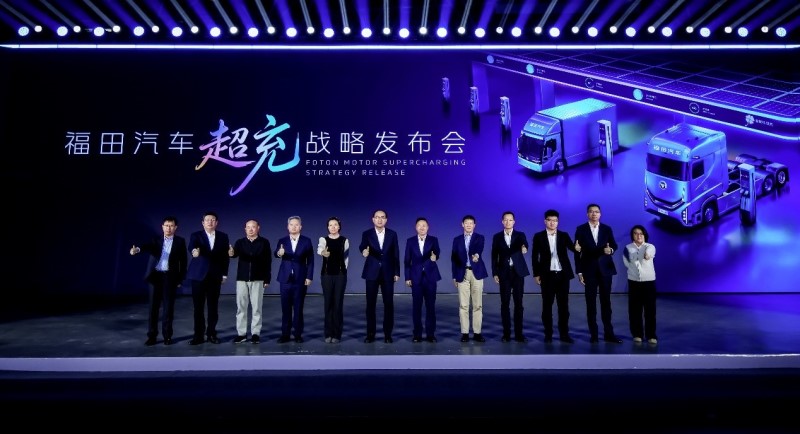
On November 6, the BAIC Foton Ultra-Fast Charging Strategy Launch Event was held with great ceremony in Beijing. Chang Rui, General Manager of BAIC Group and Chairman of BAIC Foton, Lu Zhenghua, General Manager of BAIC Foton, and other company leaders attended. Representatives of industry chain partners including CATL, Sunwoda, TELD and Jingneng, together with customer representatives and media guests, witnessed the occasion. At the event BAIC Foton officially released its full-domain ultra-fast charging ecosystem strategy and simultaneously unveiled, as world premieres, the Aumark Z ultra-fast charging light truck and a megawatt-class ultra-fast charging heavy truck — marking the formal opening of the high-power replenishment era for commercial vehicles.
During the 15th Five-Year Plan period, building an integrated "vehicle-road-transport-energy" industrial innovation ecosystem has become a key direction for the industry, with plans to form more than 50 GW of vehicle-grid-interactive adjustable capacity and deploy 300,000 high-power charging facilities. As new energy commercial vehicles extend steadily from short and medium hauls into medium and long-haul trunk lines, replenishment efficiency has become the key bottleneck constraining scaled adoption. Drawing on more than two decades of new energy technology accumulation, BAIC Foton has integrated full-chain resources across vehicles, batteries and energy platforms to launch a "vehicle-charger-network-cloud" coordinated full-domain ultra-fast charging ecosystem solution, connecting the协同 links between vehicles, charging piles, replenishment networks and cloud platforms to drive an iteration of commercial vehicle replenishment models.
Vehicle-Charger-Network-Cloud Synergy: Building a Full-Domain Ultra-Fast Charging Ecosystem
With new energy commercial vehicle penetration rising steadily and large-capacity models becoming mainstream, the industry faces practical challenges: limited single-gun charging current, insufficient replenishment infrastructure, time-consuming charging, and constrained fleet operating efficiency. At the event, Qin Zhidong, Vice President of BAIC Foton, gave an in-depth interpretation of the full-domain ultra-fast charging strategy. He noted that commercial vehicles are no longer simple transport assets but are transforming into multi-value carriers of data, energy and ecosystem. Beyond traditional freight income and the green-capacity premium, diversified commercial value is being unlocked from depot services, virtual power plant peak shaving, vehicle-battery separation and battery cascade utilization.
Relying on more than 3.5 million connected vehicles online, a daily data processing capability of 3 PB and over 770,000 linked replenishment terminals, BAIC Foton has built a nationwide transport-capacity heat-sensing network, providing a solid data foundation for the precise planning of replenishment networks.
Centered on the "vehicle-charger-network-cloud" concept, BAIC Foton has created a "four-in-one" system comprising an IoV data platform, a charging operation platform, a vehicle-grid energy interaction platform and a traction battery health management platform. On the vehicle side, it integrates ultra-fast charging batteries, a high-voltage platform, high-efficiency cooling and battery safety control; on the charger side, liquid-cooled ultra-fast charging and V2G bidirectional charge/discharge capability execute cloud commands; on the network side, load forecasting and energy aggregation dispatch open up the energy flow chain; on the cloud side, AI dispatching and full-lifecycle battery big data deliver unified awareness of vehicle, battery and depot status.
On the technology front, the ultra-fast charging battery achieves a charging rate of 4C or above and 95% charge/discharge efficiency; on heavy truck applications, six minutes of charging delivers 100 km of range, with a cycle life of more than 6,500 cycles. The vehicle's 800V high-voltage architecture is compatible with voltages up to 1,000V, opening a 1.5 MW replenishment channel: single-gun charging current reaches 800A, dual guns combine for 1,600A, with a dual-gun peak power of 1.5 MW. Addressing the thermal risks of high-power charging, the ultra-fast charging cooling system keeps the charging socket temperature rise within 40K and the traction battery temperature rise within 32K under 1,600A conditions, securing the safety baseline for high-power charging.
Meanwhile, BAIC Foton is building data-driven, PV-storage-charging integrated smart ultra-fast charging depots using 10kV AC input and 1,000V DC output, fusing photovoltaics, energy storage, vehicles and loads to upgrade depots into microgrid units capable of generation, storage and dispatch.
On ecosystem building, BAIC Foton initiated an ultra-fast charging industry ecosystem alliance with partners including CATL, Sunwoda, TELD and Jingneng, focusing on full-chain cooperation across equipment R&D, joint technology development, depot construction and energy operation, with a plan to deliver 5,000 standardized ultra-fast charging comprehensive depots. Deployment follows three models: fully self-invested construction to create benchmark demonstration depots; co-investment and co-construction with joint capital and shared returns; and outward licensing of complete equipment and technical solutions to empower the industry. Leveraging a business network covering more than 140 countries and regions, BAIC Foton will accelerate the coordinated overseas expansion of new energy vehicles and its replenishment ecosystem, focusing on Asia-Pacific, Latin America, Africa and Europe, with plans to exceed 3,000 units of overseas replenishment ecosystem installed capacity by 2027.

World-First 8C Ultra-Fast Charging Light Truck Redefines Urban Delivery Replenishment
New energy light trucks are now penetrating both urban delivery and inter-city scenarios rapidly: penetration rose from 18% to 29.7% across 2024–2025 and is expected to exceed 50% in 2026, while the cold-chain sub-segment has broken 77% single-month penetration. Long charging waits, range anxiety, fast-charge-induced battery degradation and depot queuing remain the core pain points of urban delivery and cold-chain logistics users.
Ma Lu, President of the BAIC Foton Aumark Business Unit, officially released the Aumark Z ultra-fast charging light truck. As the world's first ultra-fast charging light truck built on a native pure-electric dedicated platform, the vehicle was developed from the underlying architecture forward for ultra-fast charging requirements. It carries a peak 8C ultra-fast charging battery with substantially optimized internal resistance, achieving 97% charge/discharge efficiency and a peak charging power of 1.05 MW. Charging adds 32 km of range per minute, SOC 20%–80% takes just 8 minutes, and peak battery temperature is held within 50°C throughout the charge. For northern cold climates, 15°C/min pulse heating means that at −20°C the vehicle needs only 2 minutes 30 seconds extra to reach its optimal ultra-fast charging temperature window. The vehicle carries an 8-year / 800,000 km warranty.
The truck integrates three core systems: an 800V high-voltage architecture, liquid thermal management and the FEEP 2.0 intelligent architecture. The 800V architecture supports 1.05 MW peak charging power with a maximum charging socket current of 1,600A; the liquid thermal management system raises heat exchange by 40% and current-carrying capacity by 150%, forming a 10 kW full-domain thermal management system that uniformly controls battery, e-drive, cabin and reefer temperatures; the FEEP 2.0 architecture, built on VDCU vehicle-domain integrated control, delivers 20% whole-vehicle energy savings and battery health management identification accuracy above 99%.
The Aumark Z comes standard with V2G bidirectional charging: the vehicle can absorb surplus photovoltaic power and feed electricity back to the grid at peak demand, creating additional fleet revenue. On a real-world Maoming–Shenzhen 800 km round-trip cold-chain route, the reefer unit runs without stopping throughout, with a single mid-route replenishment stop of only 8 minutes. Supported by the planned 5,000 ultra-fast charging stations, the service network will cover 368 cities. For the first 800 customers, BAIC Foton offers eight ultra-fast charging privileges worth RMB 19,888, including purchase subsidies, financing policies and downtime compensation, layered with a three-year 40% residual-value buyback — comprehensively lowering total cost across purchase, operation and replacement.

Megawatt-Class Ultra-Fast Charging Heavy Truck Arrives to Solve Trunk-Line Replenishment
Addressing the industry challenges facing trunk-line heavy trucks — incomplete supporting infrastructure, operating efficiency and three-electric safety — Chen Peng, Vice President of Foton Auman R&D, unveiled the megawatt-class ultra-fast charging heavy truck. The product spans two series, Auman Galaxy and Cavan Xinghai, and can serve diverse trunk-line transport scenarios including express and fast freight, cold-chain distribution, port short-haul shuttling, coal and aggregate haulage, and heavy industry.
The model is the industry's first scaled mass-production heavy truck on a through-type 800V high-voltage platform. At equivalent power, charging current falls by 30%, line losses by 50% and three-electric system heat losses by 15%, delivering high efficiency in high-power transmission. The battery uses a module-less integrated design with a high-strength, lightweight enclosure; AI ultra-fast charging algorithms dynamically optimize the charging curve, balancing high-power charging against battery life to achieve a 6,500-cycle lifespan. Under real test conditions the vehicle sustains a stable 1,600A charging current and maintains a high current even at 80% SOC.
The truck features an all-new Engine Bay 2.0 integrated cooling module that cuts weight by 23%, reduces module complexity by 50% and lifts system thermal efficiency by 10%, holding cell temperature steadily in the optimal 25–50°C band. It supports vehicle-charger coordinated scheduled charging and 23 remote intelligent control functions. Measured data show 1 kWh is added in 2.6 seconds, SOC 20%–80% takes 18 minutes, and six minutes of charging yields 100 km of range, with peak temperature held within 50°C throughout.
On safety, a five-layer full-domain protection system spans battery, architecture, system, whole vehicle and vehicle-cloud coordination, having passed more than one hundred extreme tests including nail penetration, fire, drop and water fording, with a whole-vehicle wading depth of 0.9 metres. The three-electric system is fully developed in-house, with the VCU vehicle controller orchestrating the powertrain, shift logic, long-grade torque and thermal management. Calibrated across all scenarios — extreme heat, high altitude, extreme cold, long descents, ports and mountain curves — the vehicle handles complex road conditions with ease and possesses all-terrain operating capability.
On intelligent features, the full range offers 22 advanced driver assistance functions, improving whole-vehicle safety by 67% while cutting energy consumption by a further 3%. Combined with more than 50 technologies including ultra-low drag and lightweighting, whole-vehicle energy consumption is 5%–8% better than the industry average and operating efficiency is 10% higher, providing an efficient and reliable transport solution for trunk-line bulk logistics.

With the momentum of ultra-fast charging, empowering transport. Facing the second half of new energy commercial vehicle competition, BAIC Foton will continue to leverage the synergistic advantages of vehicles, batteries and the energy ecosystem, working with industry chain partners to build a PV-storage-vehicle integrated vehicle-energy interaction ecosystem, extending the ultra-fast charging network across urban delivery and trunk-line logistics scenarios, helping the logistics industry reduce costs and raise efficiency, and accelerating the commercial vehicle sector's green and low-carbon transition.