Structural Growth Takes Hold: BAIC Foton Sells Over 56,000 Units in October as Growth Momentum Continues to Build
In October, China's commercial vehicle industry entered a period of deep adjustment under a high base. As demand for conventional fuel vehicles eased in stages and the heat around natural gas models receded, the industry's total growth rate began to shift gears. The growth engine has formally moved from cyclical recovery to three long-term main lines — new energy penetration, globalisation and intelligent upgrade — while market resources are accelerating their concentration toward leading enterprises that possess full-chain technology capability and a global footprint.
As a leading force in China's commercial vehicle industry, BAIC Foton has seized this window of structural reshaping, anchoring itself to the strategy of "comprehensive internationalisation, comprehensive new energy transition and comprehensive intelligentisation." It has deepened localised operations in overseas markets, deployed world-leading technology in the new energy field, and expanded its industrial ecosystem in the intelligent driving lane — using multi-point, structural growth to offset cyclical volatility and keeping overall operations on a steady upward trajectory.
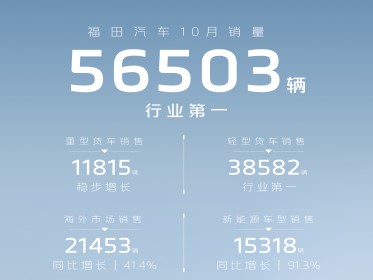
Latest production and sales data show that BAIC Foton sold more than 56,000 vehicles in October and more than 574,000 units in January–October, up 7% year on year. Within that, overseas markets sold more than 21,000 units in October, up 41.4% year on year, while the new energy business sold more than 15,000 units in October, surging 91.3% year on year. Growth in the core lanes continues to outperform the industry average, further consolidating the company's leading position.
Global footprint deepens; localised operations unlock long-term growth resilience
Exports have always been the core pillar by which the commercial vehicle industry smooths domestic cycles and opens up growth space. To date, BAIC Foton has ranked first in Chinese commercial vehicle exports for fifteen consecutive years. In October, its overseas strategy extended further down the value chain — shifting from product export and capacity export to the export of services and systems, and upgrading the overseas business from "scale growth" to "value growth." Full-vehicle exports exceeded 21,000 units in the month, up 41.4% year on year; cumulative exports for January–October surpassed 189,000 units, up 43.4% year on year. The share of high value-added products such as new energy models and premium heavy trucks keeps rising, strengthening the profitability resilience and risk resistance of the overseas business.
The localised service system gained another key piece, further widening the moat in emerging markets. On October 27, the Foton Africa Regional Training Centre was officially completed in South Africa and opened its first cohort, with a curriculum spanning product technology and repair, after-sales service systems, and operations and maintenance capability. It will serve partners and end users across the African continent. Working in synergy with existing localised plants and channel networks in Africa, the centre builds a trinity localised ecosystem of "manufacturing + service + channels" — both a service backbone for Foton's deep cultivation of overseas markets and an important marker of Chinese commercial vehicle brands accumulating localised value.

Regional ecosystems are being bound more deeply, with major overseas orders landing in clusters. On October 29, the Foton Africa Regional Partner Conference themed "Drive to Great" was held in Port Elizabeth, South Africa, gathering nearly 700 dealers, key accounts and industry partners from 42 African countries. The company released its Africa regional strategy report on site, proposing a deepened development path built on three pillars: a localised product portfolio, a local business ecosystem, and local manufacturing and operations. The conference produced concentrated order signing and delivery: 1,000 heavy trucks delivered in Ghana, 800 heavy trucks delivered in Zambia, and purchase agreements of 200, 100 and 100 vehicles signed with Mozambique, Ethiopia and Kenya respectively. A new energy product cooperation was also reached with Zambia, covering mining and agricultural green transition scenarios — sustained proof of all-category product competitiveness in overseas markets.
Breakthroughs in both technology and scenarios; the full new energy range leads with high growth
In October, new energy commercial vehicles remained the sub-segment with the highest certainty of growth in the industry, with penetration continuing to climb. Relying on an all-category product line-up and an in-house three-electric technology system, BAIC Foton not only maintained rapid sales growth but also achieved industry breakthroughs in the mass-production deployment of frontier technology, upgrading its new energy business from scale expansion to technology leadership. Full-range new energy vehicle sales exceeded 15,000 units in October, up 91.3% year on year.
By brand: Auman new energy +79.6%, Auhaw/Aumark new energy +241.5%, Ollin new energy +137.7%, Toano new energy +117.2%, pickup new energy +215.6%, Cavan new energy +119.5%, and overseas new energy exports surged 836.4%. From core domestic scenarios to global markets, from trunk-line heavy trucks to passenger-grade urban distribution, every business line advanced in parallel — establishing a healthy, all-line growth structure for the new energy板块 and making its scaling momentum increasingly evident.
Frontier technology reached mass production first, opening a new lane for commercial vehicle energy interaction. On October 27, BAIC Foton launched in Guangzhou the world's first mass-produced V2G commercial vehicle — the Fengjing i — together with an integrated vehicle-charger-grid-cloud V2G solution. On the AC side it supports bidirectional interaction through an OTA upgrade with zero hardware modification; on the DC side, high-power real-pile validation has also been completed. This turns commercial vehicles from simple transport tools into mobile energy storage units, opening an entirely new path to cutting operating costs and lifting efficiency.

Penetration of细分 scenarios continued, with benchmark orders landing one after another. In municipal sanitation, the company won major projects in succession — the Leshan garbage sorting and transport vehicle project and the Lhasa municipal sanitation facility renewal project — covering 228 sanitation work vehicles and supporting facilities and achieving scaled application of new energy sanitation equipment under complex plateau conditions. In energy transport, multiple powertrain categories were adapted to special transport needs in north-west China, validating the all-condition fitness of Foton's new energy products. Foton's new energy line now covers heavy trucks, light trucks, vans, buses and special-purpose vehicles in full, with scenario-based competitiveness rising steadily on the strength of the AiYiKe three-electric technology system.
Intelligent ecosystem expands faster; technology and standards drive commercial deployment in tandem
In October, BAIC Foton's intelligent strategy entered an acceleration phase of ecosystem co-building and scaled deployment: complementing scenario capability through technology cooperation, leading industry direction through standards output, and delivering commercial value through batch delivery — moving advanced commercial vehicle intelligent driving briskly from technology validation to scaled commercial use.
The technology ecosystem expanded again, with the all-scenario intelligent driving layout continually completed. On October 8, BAIC Foton signed a strategic cooperation agreement with Zhuoyu Technology (DeepRoute.ai-class partner), with the two sides cooperating in depth on all-scenario commercial vehicle intelligent driving covering heavy-truck highway and national-road navigation assistance, intercity highway NOA, unmanned logistics vehicles, and urban NOA for light commercial vehicles. Combining Foton's deep vehicle-manufacturing and chassis-integration capability with the partner's full-stack in-house intelligent driving technology and multimodal large-model capability, the two will advance technology mass production in phases to accelerate the普及 of advanced commercial vehicle intelligent driving.

Industry standards came first, guiding the intelligent driving industry towards regulated development. On October 29, BAIC Foton released the industry's first Blue Book on Intelligent Driving Heavy Truck Demand in China, systematically setting out the intelligent driving demand characteristics, technology evolution path and commercialisation pace for core scenarios such as trunk-line logistics, ports and mining areas. It provides the whole industry with a clear demand reference and development guide, and further opens Foton's "Cangqiong" (Azure Sky) intelligent driving technology system to the sector.
On the market side, intelligent driving-assisted heavy trucks were delivered in batches to a leading cold-chain logistics enterprise, forming China's first scaled intelligent cold-chain fleet, which uses the highway navigation pilot assistance system to achieve a three-fold optimisation of operating efficiency, safety performance and energy consumption. Foton's in-house Cangqiong intelligent driving large model has now closed the loop across perception, prediction, planning and control, and Auman Galaxy series intelligent driving heavy trucks have entered scaled mass production and delivery, covering the country's core logistics trunk lines — with the commercial value of intelligent technology continually being realised.
As the transition from old to new growth drivers deepens, structural divergence within the commercial vehicle industry will persist, and technology, brand and globalisation capability will become the core determinants of long-term corporate standing. BAIC Foton will continue to deepen its three strategic layouts — consolidating product barriers through technological innovation, expanding growth space through global deployment, and accelerating intelligent落地 through ecosystem co-building — continually improving development quality and profitability, staying ahead amid the industry's transformation, and leading China's commercial vehicle industry towards higher value, greener power and greater intelligence.